Showing posts with label Reviews. Show all posts

Wednesday, November 16, 2011

Album Review: Ian Kamau - One Day Soon


“We believe in a gaze that is shorter than our goals/ as empty as our pockets and as stubborn as our souls/ holding stones, looking for a place for our hands to hide/ standing in a place where many took a stand and died/ feet inside the earth, eyes towards the skies/ the land that we live on is the same they occupied/ unsure if our story is a blessing in disguise/ we pray to see the light but we will not open our eyes…”
                                   
-Ian Kamau, “Maybe” (track #9 - One Day Soon)

For anyone familiar with Toronto’s hip hop, spoken word, poetry, or music community in general, Ian Kamau is known by many as a staple artist and pillar of the communities that he represents. Having released several projects in the past (2 EPs, 3 Mixtapes, 5 Podcasts), Kamau’s latest release and first official full length album, One Day Soon, is a strong testament to his creativity, depth of content, and growth as an artist to those who have been following him, and a great introduction for first-time listeners. It would be quite difficult to fit Ian Kamau or One Day Soon into a specific genre; predominant spoken word and hip hop vibes echo throughout the album, however it might be better to simply characterize this LP as soul music. For those seeking an immersive listening experience, something not only to nod your head to but to absorb and reflect on, One Day Soon possesses a wealth of Kamau’s accumulated perspectives and personal wisdom.
One Day Soon is a heavy and lyrically-packed album at times, requiring listeners to attune their ears to rapid-fire flows and emotionally charged words and phrases (e.g. track # 12, “Black Bodies,” in which Kamau expresses his frustration at the violence and death that plague the black community). Kamau juxtaposes the faster-paced hip hop songs on the album with more mellow tracks on which he spends most of the time singing (e.g. track #8, “Sleeping Giant”), nonetheless still expressing powerful and inspired ideas. In fact, Kamau does a great deal of singing on this album, displaying his ability to embody different spaces as an artist both vocally and in terms of his role on each track. One Day Soon is a very ambient LP, due not only to his atmospheric production (yes, Kamau also self-produced the entire album), but largely due to the way Kamau’s smooth background vocals compliment his spoken words/raps, which at times can come across as a bit monotonous sounding on their own.
This LP is an album of bold statements and complex ideas. The first line on the album, “I am a new kind of human being” (track #2, “Heading Home”) is a great summary of the kind of thinker that this artist is. Kamau is a heavily reflective and philosophical thinker, as evident by the lyrical content of his work. There are times on the album when it seems that Kamau is a full-fledged idealist and dreamer: “we’ll speak our mind, seek and we’ll find/ the ties that will bind us, the trees to the vine/ our roots only help us in being divine/ and forcing the change we’ll be seeing in time/ and believing in signs that we will overcome” (track #3, “The Village). Even the title of the album (One Day Soon) expresses a yearning and hope for a better world and life. It’s clear, however, that Kamau is also a realist and is keenly aware (even at times painfully so) of the harsh realities of the world around him: “black stakes in the heart/ bullets, like bats, tend to fly after dark/ we make sure the children are home from the park/ a shame - every day, another name to discuss/ flood the streets with their guns and they blame it on us” (track #12, “Black Bodies”). Kamau’s messages throughout the album are thematically focused on confronting difficult issues in society and uplifting the communities around him.


Ian takes responsibility for being the voice of a disenfranchised black community, the voice of an alienated and uncertain generation facing tumultuous circumstances. He expresses with sharp words and astute insight the damaging effects that the history of slavery and cultural displacement have had on black people: “torn from our home/ born in a new world, we’re more than alone/ and the more that we change, more we stay the same/ sat and prayed at the place that the slave-ships came” (track #3, “The Village”). One Day Soon is not simply a recounting of past horrors and there is definitely not a tone of victimhood in Kamau’s lyrics; quite contrarily, the artist seems to look with fondness and admiration at his community, for all of its accomplishments despite their harsh conditions. Track #8, “Sleeping Giant,” while targeted towards the black community, is an inspirational tribute to oppressed communities everywhere: “louder than your empty promise, louder than your arms/ louder than your foolish comments, louder than your bombs/ bigger than your false division, keeping us apart/ louder than your false religion that warps the truth inside our hearts.” It is perhaps that Kamau has uncovered his own greatness through his art, despite facing the same obstacles as the people around him, that he is able to see the greatness in other human beings, despite the difficult conditions that they face and even internalize within themselves.
While he seems to be focused specifically on problems affecting Toronto’s black community and the history of people of African descent in general, Kamau’s reflections are universally applicable because the struggles he expresses are, fundamentally, human struggles. On track #13, “Traffic,” Kamau talks about the human tendency to go after short-sited goals, fulfill base desires, and run on autopilot whilst neglecting spiritual needs and broader societal issues. While the historical circumstances of his community are specific, the recounting of past relationships and stories from his own life make clear that people from all walks of life deal with similar human conditions. A pervasive theme in Kamau’s writing is a coming to terms with clichés and idealized values that are in contradiction with life experiences. On track #5, “Now That I’m Alone,” Ian confronts the heartaches of a past romantic relationship that still occupies space in his psyche. Expressing disillusionment with common notions of love, relationships, and romance, he repeatedly sings “I guess love aint enough” on the chorus, as he recounts the circumstances that led to the severing of ties with his former romantic partner in his verses. On “Maybe” (track #9), Kamau courageously displays his own vulnerability, fears, and pain, which are evident both in his lyrics, “so often I sit in places I’d rather not be/ my eyes embrace realities I’d rather not see/ my angels and my demons, they are constantly warring/ and the things I do at night often catch me in the morning,” and in the tone of his voice on the track, which seems quiet and meek in contrast to his resonant voice on other tracks. It’s clear after listening to the song a few times, however, that “Maybe” is perhaps one of the most emotionally touching and lyrically powerful songs on the album, largely due to the artist’s honesty and open sharing of his own self-awareness.
While being a singer, emcee, philosopher, spoken word artist, community activist and more, it’s clear that Ian Kamau is a poet at heart, as evidenced by the vividness of his writing and skilled use of language throughout his work. One Day Soon is not only a great work of art, but is incredibly relevant to issues facing modern society and the world as a whole. What makes Kamau’s work so credible and touching is that he is coming from a place of both acknowledging and accepting the inequities he sees around him without condoning them, while at the same time standing for a greater future for himself, the people he knows, and the world around him. For anyone who believes in building towards a brighter future for the human race in the face of seemingly insurmountable odds, for anyone who is a lover of poetry and good music, and for anyone who loves art in and of itself, One Day Soon is a must own.
“We’ll never have a renaissance, ‘cause we stand and point our finger, but we’re all confused/ you’ll never have a renaissance, if you say you’re for the people but it’s all for you/ we’ll never have a renaissance, ‘cause we say we’ll get together, but it isn’t true/ we’ll never have a renaissance, if we speak about a movement, but refuse to move.”
                                      
                                 -Ian Kamau, “Renaissance” (track #16 – One Day Soon)


Wednesday, October 26, 2011

Album Review: MC FÜBB - In the Face of No Agreement (by Andy Carrington)


"Here be a hungry, intelligent and creatively-gifted man, whose album thrives on the strength of his beat riding, confident vocal tone and range of subject matter, all of which become a warming familiarity early on." -Andy Carrington (andycarrington.co.uk)


Peep the review written by Andy Carrington over in the UK on my most recent album, In the Face of No Agreement. 4.5 stars out of 5? I'm humbled, sir! Click the image below to read:


Monday, October 10, 2011

Album Review: The Antiheroes – this is freeDUMB


            Easily one of the most talented and fresh-sounding duos in the world of rap, The Antiheroes’ (Sha Prince and Flex) debut LP, this is freeDUMB, is both musically a great contribution to hip hop and a powerful criticism of modern society and culture. Throughout the album, the two MCs not only point out the obscenities that they perceive around them, both in regards to the hip hop scene and the world at large, but they also poignantly express their own internal dialogues and struggles they face as artists and human beings. Most importantly, Flex and Sha are lyrically able to accomplish their thematic goals without sounding corny or repetitive. Each track on this album sounds like its own distinct single and evokes different emotions in the listener, despite producer MMac producing 8 of the 17 tracks (a testament to the beat-maker’s versatility and creativity). this is freeDUMB is an album not only for those who love high quality hip hop music, but even moreso for those who love and appreciate strong lyricism that touches on deep concepts and complex issues.
            The album opens with an eloquent and heartfelt verse by Flex over a lovely synthetic organ-laden beat by MMac and sharp cuts by DJ Docta. Flex, through bar-filled flows and with an ear-pleasing, mid-high frequency arioso tone, raps about his frustrations in facing obstacles to success as an artist. What rings through loud and clear though is not cynicism in Flex’s verse, but rather a passionate commitment to succeed (and with these kinds of lyrics, it’d be a damn shame if he doesn’t): “I’m so committed to living within an image of doing whatever’s fitting/ for me to be in position to give ‘em what they were missing.” Flex also speaks on a value that both he and Sha seem to hold dear to their art when he spits: “honestly is my honesty necessary to blow?/ is selling your soul the recipe? I was hoping it’s no.” It’s clear from listening to this is freeDUMB a few times that The Antiheroes are not willing to compromise their content or dumb-down their self-expressions in order to make music that may be more commercially viable or marketable to the masses. That’s not to say that this is freeDUMB isn’t commercially viable; if anything one of the reasons the quality of their work is so strong is that these artists don’t settle for less than raw authenticity in their music. On the same title track, Sha Prince (bringing a sharp delivery, and on-point intricate flows to the table) reflects on his own self-doubts and personal life choices, which he worries may contain an opportunity cost that doesn’t add up in his favour: “life – I never rush it/ I’m rolling with my punches/ maybe I slow it too much and now I’m running lunges” and “being a rap-star isn’t in my best interest.” Undoubtedly, Sha echoes the same hunger and passion in his verse as Flex does, firing off intense and ferocious flows: “in a verse, on a record, some may say he talk reckless/ but never give a damn, since a kid my mind rebellious/ and I eat these rappers’ lunch, dinner, breakfast on a tracklist/ only spitting two years, word almost perfected.” For a rapper only spitting for two years, Sha Prince displays a lot more talent and skill than many who have been in the game for a decade.
            Jon Dubbs supplies a rock-symphonic instrumental on the second track, Become Alive, complete with guitar riffs and violin melodies on the chorus. Flex and Sha articulate their internal conflicts on this track perhaps better than any other on the album. Sha Prince in particular, never a stranger to expressing brutally honest and at times even extreme thoughts on wax, goes in on his conflicting desires for wealth and material success in contradiction to staying true to his own values and principles: “living lavish was never my goal/ ‘till my hunger rose, belly ache, winter froze/ lights dim, looking at my situation inside impatient eyes/ temptation is now my best friend/ worst enemy, lord seek the remedy/ lead me on the right path before my body doesn’t breathe.” Sha’s erratic flows on this track excellently compliment the frantic nature of the opposing thoughts being vented on this track.

Circus Clowns (track #3), another engrossing production by MMac with DJ Docta cuts, is a poetically infused track in which The Antiheroes attack the rap scene which they perceive as becoming little more than a “circus of clowns.” Sha and Flex stake their claim as MCs to be reckoned with on this track and confidently announce their goal to elevate the standards of what is deemed to be acceptable, quality rap music (also check the remix on the album’s final track).

Fly (track #5) is an inspirational track with captivating samples by producer Jay Emess about finding motivation and self-empowerment by being grateful and focusing on living out dreams in order to elevate over current circumstances.

            There’s a slew of talented features on the album. Soulful songstress Tamsynn Lee blesses track #4, Masquerade, (as well as track #9, All Alone) which is a song that digs below the surface to reveal the underlying causes of unfortunate life circumstances that have become all too commonplace in the world. Prolific Durham Region rapper Daxflow makes an appearance on Everyday (track #6, produced by Beatwyze, DJ Docta again on the cuts) on which he vents his anger about his abusive, selfish, irresponsible absentee father, while Sha Prince speaks on the painful experiences of his past that he kept inside and Flex reveals that expressing himself via writing and rapping has been vital to his existence: “what’s living if I’m within a prison built up inside?/ if it wasn’t written, I’d never find a will to survive.” Everyday is an especially insightful track as each of the lyricists describe in their own way (whether explicitly or otherwise) how hip hop, via writing and rapping (i.e. being emcees), has given them the ability to stay sane and live productive, meaningful lives despite the trying circumstances they faced growing up. The Rebels (Listen Up) (track #7) is one of the heaviest hitting bangers on the album, thanks in part to the banging beat produced by up-and-coming Toronto producer RichKidd. This track is definitely an attention grabber (evident in the title of the track), with high-impact lyrics, punchy deliveries from both Sha and Flex, and complete with a feature from the always entertaining D-Sisive: “fuck you, your momma and your cousin too/ your momma’s gay husband’s uncle’s brother, and his cousin too” (yes D…you got our attention...).

Singer Emerson Brooks (recently signed to Atlantic Records) provides a unique hook on Where to Begin (track #12), a song about relationship troubles and past relationships. Kenny Cee, another skilled vocalist, sings the chorus on Given Up On Me (track #13), a track produced by Khz with a sample that sounds eerily similar to Zepplin’s Stairway to Heaven. Flex and Sha Prince complement each other very elegantly on this track, with Flex delivering a calmer, more melodic verse with reflective and well contextualized lyrics about his past, whereas Sha raps with a much harsher tone and abrasive cadences, which match the animated and harsh content on his retrospective verse. Gospel-style R&B singer Mike Devine compliments track #16, Morning, with his passionate and ambient voice. The beat on this track, produced by Graffic, is probably the calmest and most laid-back beat on the album, which evidently doesn’t suit The Antiheroes style very well, unfortunately – both Sha and Flex sound a bit harsh over this track, which could have benefited either by them toning down their deliveries a bit or by a smoother vocal mixing by the engineer.
The Antiheroes give a vividly dispelling treatment to the dirty underbelly of the “Hollywood lifestyle” of entertainment on Hollywood (track #10), produced by triple-threat artist Relic. One of my personal favourites on the entire album (which is hard to say, given how dope the entire project is) is the track OJ Gloves (track #11). There’s something very serious and polished about Sha’s tone and delivery on this track, showing that even when he simplifies his flows he can still spit hard and impress with the best of them. Flex also comes correct and on point on OJ Gloves, at times with flows reminiscent of Big Pun (with a clearer voice and less laboured reathing). Lyrically, both emcees prove how bright they can shine in this song (albeit each in their own way), Sha with his clever vulgarity, “laughing, like my first name Freddy dude/ last name Kruger but filthier than a prostitute/ not on my level – never reach my altitude/ finger hurt from skipping your tracks like they was interludes,” and Flex with his intellectual superiority, “I take it some of you followers swallow what you were fed/ you wallow within your own – I’m stepping over your head.” Track #15, Of the Night, is definitely a hidden gem on this album, with The Antiheroes coming raw with flows that remind the listener of classic Planet Asia verses and lyrics that evoke the feelings of dark alleyways and late nights with shady characters in the wrong part of town. MMac again supplies an excellently produced instrumental for this song that evokes memories of Pharaohe Monch’s Internal Affairs album.
There’s an overarching sound on this is freeDUMB that can best be described as a romantic requiem in response to a dead and pure form of hip hop that has been lost over the years. In a broader context, there seems to be an undertone in the MCs words expressing a nostalgic eulogy to naïve dreams, desires, and values that, while not being abandoned, have had to be tempered and adapted to certain harsh realities they now face. Flex and Sha Prince are, for the most part, a very complementary pair of artists throughout the project. Flex endows The Antiheroes’ sound with a sense of stability in terms of rhyme pattern, flow structure, and smooth delivery while Sha Prince contributes unpredictability with intricate flows, harsher tones, and a gritty feel to his verses. After listening to each artists’ lyrical content, particularly their respective interludes (Flex on track #8 and Sha Prince on track #13), it seems that despite both of them coming from difficult childhood upbringings, Flex is a bit more at peace with his past that Sha is. The difference in the places on their life journeys between the two artists, while the divide doesn’t seem to be too big, makes for an interesting dichotomy throughout the project. It’s hard to fault either MC for anything; both of the rappers are technically almost perfect with their flows and their styles are well defined. To be nitpicky (and I am stretching for constructive criticisms here), Flex’s voice and presence on the tracks can at times sound a bit monotonous from song to song (despite switching up his flows and rhyme structures). Sha Prince, on the other hand, can occasionally go a bit far with the complexity of his flow structure, which can sometimes obstruct the vibe of the track. Most listeners may not put this album on repeat and listen to all the minute details and technical elements in the music, however I encourage them do so – if they are lovers of hip hop, they will be hard-pressed to find anything to give this album flack for. The Antiheroes have set the bar very high for themselves on their debut LP, and I hope that the world starts to take notice of the immense talent that is embedded on the wax (or plastic or digital encoding) of this is freeDUMB.


Thursday, September 22, 2011

Tuesday, September 20, 2011

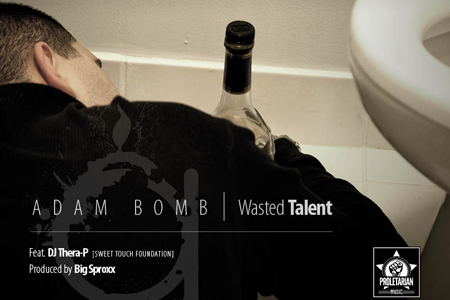
Album Review: Adam Bomb – Wasted Talent


            Up until recently, Toronto hip hop MC Adam Bomb (aka “The Legend”) was known mostly for his work in collaboration with the group Empire. His contributions of hard-hitting punch-lines, witty lyricism, and raw delivery have garnered him a reputable name for himself, standing out even among his talented peers. With what seems to be a break-off from his involvement with Empire and joining the ranks of the newly form T-Dot super-group Freedom Writers, it’s no wonder that Bomb touches on his career struggles and transitions in outlook and focus on his solo album, Wasted Talent.
            The Legend sets the tone of this album – heavy, deep, and self-reflective – with the first track (and my personal favourite on the entire record), Wouldn’t Understand. Touching on his views of stardom, staying true to his craft, and ultimately the fallout with Empire, Adam Bomb elegantly paints a picture of the mental landscape in which he finds himself. The second verse of this track particularly stands out as it reveals the reasoning behind his recent career choices: “This one-man route’s new to me/ wasn’t planned out yet it panned out beautifully/ hold up – before fans shout mutiny/ and ask about the band, ask the band about unity.” It seems from these lines that while Bomb didn’t want to separate from the group, he found it hard to find agreement in career choices from his peers. He confirms his reluctance and reasons for leaving as he spits: “hate to see the day when an ‘A’ substitutes an ‘E’ on the jewellery/ but I refuse to keep waiting patient ‘till dudes agree.” Adam Bomb is clearly hungry and ambitious to pursue his career as an artist and push himself musically, and it seems he feels he wasn’t getting the same kind of dedication from the rest of the rest of the Empire crew. In the last verse, the artist reveals the underlying motivation and the need he has to push himself forward in life, as he writes: “The problem is depression/ the solution is constant positive progression.” Adam Bomb is an artist with an internal hunger and need to achieve and push his music out into the world, and it’s clear from the way he’s spitting on Wasted Talent that he’s ready to take on the world.
            Cue to track #3, the title track of the album, where Bomb ferociously spits one of his first tracks released under the Freedom Writers banner, laced over intense percussions and samples supplied by Big Sproxx. While always one to inject a healthy dose of socially-conscious lyrics amidst his rugged and raw content, Legend has definitely taken his new affiliation seriously, delivering some intelligent and harsh criticism of the powers that be in capitalist society: “Unless you into serving they need/ I suggest you second-guess every word that you read/ they ain’t concerned if you bleed, they ain’t concerned if you breathe/ they’re only concerned tryna feed their own personal greed/ and the succeed…” He also explains his rationale behind remaining an independent artist and not signing to a label (as they are part of the same corrupt system that he’s criticizing): “I stay independent and get paid independent/ ‘cause if I’m broke, ain’t nobody walking away with a check.” Bomb absolutely murders this track, and if anybody needed evidence that The Legend hasn’t lost his touch – this track is it (video below):


            Wasted Talent is a not a conceptually limited album, touching on a variety of topics that Adam Bomb gives a proper treatment to. On track #4, Not Me, the MC puts a final nail in the coffin of those trying to portray the façade of being “gangsters and killers” in their music despite having no street credibility. He dispels the illusions of young lust feigning as love in track #6, Running Scared, addressing the issue of pregnancies out of wedlock and taking runaway fathers down a notch with his insightful anecdotes. Let Me Down Easy (track #5), a song about the complications of relationships and the heartaches of breakups, has some banging production provided by Phat Tony. Hearing Bomb switch up from his regular delivery over a smooth rhythmic beat to a rough, accusational tone over a busy, trumpet-filled instrumental, and back again, makes for a very entertaining listen. Adam Bomb sums his cynical view on relationships well when he spits: “you only get left tryna treat a chick right.”
            There’s no shortage of features and collaborations on this album (tracks #7, #8, #10, #11, and #13). It’s nice to see that Bomb still chose to include his Empire crew on the album, with Tekman on track #7, The Balance, and more crew members on track #10, Silly Rabbits (the second track on the album criticising the “tricks” that women can play on men in relationships). Freedom Writers features definitely stand out on the album as well. Track #8, No More, is a homage to Biggie Smalls with dope production supplied by Rich Kidd, a well-crafted verse by Freedom Writers member Tona, and a great attack on rappers not holding their own weight in the game. Wake Up (track #13), featuring Freedom Writers members Frankie Payne and Theo3 and produced by Big Sproxx, is another socially-conscious track, and is a great teaser for upcoming FW projects, leaving the listener wanting to hear more. Anyone who works somewhat of a dead-end job or simply is working just to pay the bills and is looking for an uplifting track and some motivation should put track #12, My People, on repeat (shout-outs to Big Sproxx for the lovely production). Video:


            As the title of the album suggests, Adam Bomb likely wasn’t thinking too highly of himself at the time he put out Wasted Talent. The album cover shows The Legend passed out/leaning on a toilet drunk with a bottle in his hand, and he touches on his struggles with alcohol addiction a couple times throughout the album. While seeming to be down on himself and having a cynical and morose attitude throughout the record, there is also a tone of determination and a bit of a paradigm shift occurring in the artists’ psyche. On Black Limoz (track #11, complete with hypnotic vocals by Monique), Bomb talks about the various factors in his life that he thinks are keeping him down (lack of money, too much drinking, women, lack of professional appreciation for his music, family issues, etc.). It’s clear that he’s hard on himself and reached a point of being fed up with the state of his life as he spits: “I guess I’m not the man I’m supposed to be/ man, I’m supposed to be THE MAN!” Bomb even goes as far as expressing thoughts of being ready to die in the second verse. Even within this track, however, the shift in Bomb’s perspective from downtrodden to focused and determined is evident, as he starts off saying he’s “giving up” and flips the script after the second verse, recalling all the people he knows who refuse to give up living despite their own struggles. The artist seems to find some much needed inspiration in the strength of the people in his life, and as a result finds the strength in himself to keep on going: “I guess it ain’t as bad as it seems/ and I ain’t ready for these black limousines/ please – I’m not giving up.”
            There’s no doubt that Adam Bomb is an all-around powerhouse of an MC. His vocal presence on tracks is booming and his voice is distinct. His flows are on point and his delivery is powerful. He’s lyrically witty, with both socially conscious insights and punch-lines and wordplay that rank him with some of the best on the mic. After listening to Wasted Talent several times, I really started rooting for the artist – he’s got an honest charisma, despite his sometimes blatant negativity, that makes the listener want him to win. If anything is lacking on this album, it’s perhaps a bit more of an explanation on the artist’s part as to how he can overcome the struggle’s and adversity he’s facing, which would give the listener a bit of hope as well. Adam Bomb is clearly intelligent and keen enough to see the problems in the world around him and express them eloquently on wax. It’s my hope that The Legend can begin to articulate his perspective on the solutions to the problems he perceives in the world around him and in his own life on future releases. Keep on moving Bomb – we’re glad you’re not giving up.


Album Review: Promise - Awakening


Get the album HERE.
            For those who are thus far unfamiliar with Promise, Awakening is a good time to get familiar. Originally from Toronto, Promise moved to the US in recent years and is currently being managed by Duck Down Music. Released in 2011, Promise’s most recent album, Awakening, is a musically rich and lyrically engaging listening experience.
            Right from the get-go, the first track on the album, The Wake, engulfs the listener into the context in which Promise writes and pursues his life and a career as a rapper. Promise is a devout Christian, and he isn’t shy about making this fact known in his lyrics. Throughout the album, P touches on his internal conversations with God and how his spiritual connection and religious upbringing influence his life and the message in his songs. While Christian themes and religious overtones may turn off some listeners, Promise is committed to stay true to himself and his convictions and makes no apologies for keeping it real to his core values. More astute listeners won’t be taken back by Promise’s lyrics – he manages to walk the fine line between delivering a conscious-minded message and being preachy very well. Most of the time, he’s able to infuse his spiritual beliefs into his music in an empowering and uplifting manner, encouraging his listeners to look at themselves, their lives, and encourage them to be better people in the world. For those who are averse to hearing about promises of a better afterlife/heaven, you may want to avoid track #4 (Hereafter).
            Being a rapper and at the same time being religiously oriented makes for an interesting dichotomy that can be heard in Promise’s lyrics throughout the album. It’s often the case that rappers/MCs are expected to be egotistical and self-aggrandizing in their content, which Promise does delicately at times, while at the same time striving to be humble and giving the credit for his talents, skills, and blessings up to God (check track #2, Clark Kent). And make no mistake – Promise is not lacking in talent and rapping ability on the mic. His vocal presence is strong and melodic, while his vocal tone and cadences come across as sincere and heart-felt. When it comes to flows, P definitely doesn’t follow the cookie-cutter approach that is all too prevalent in the world of rap music, and he isn’t afraid to change up his rhyme patterns quickly between bars. Having seen some of his live performances as well, I can safely say he’s an all-around great MC, and holds it down just as properly live as he does in the booth.
            Lovers of Tupac Shakur’s song Changes should enjoy track #3 (Something Better), which melodically and lyrically seems to be a bit of a tribute to the late artist (albeit with a more religious and less “thug life” message). There are an abundance of talented vocalists on Awakening, which makes for a very rich listening experience, and it would be hard to simply classify the album as a “hip hop” record. Awakening definitely fits into the “soul” category and, some may say, the “holy hip hop” category. I encourage listeners to give up their labels for this one, however, and simply sit back and take in the album (suffice it to say that it fits into the category of “good music”). For those looking for straight lyricism, punch-lines, and creative flows, check out track #7, Against the Odds. With a contagious hook by Jhene Aiko and an in-depth look into the mind of the artist, this is easily one of the best tracks on the album (close second/possibly a tie goes to track #5, Everyone Knows feat. Tony Williams). Check some of the lyrics from Gonna Make It:

“Labels that I wanted to sign, would want to me shine, they don’t want me to rhyme, they want me to lie and sign posters/ I was like, “you outta your mind?” so I had to decline, and now I’m just rapping to find closure/ I know, when the sun shines it’s over/ compromise my art? no sir/ if the sky don’t part, my hopes will help me to smile in the Dark Knight – Joker” –Promise

            Another personal favourite track on the album is #9, Somebody Else. Featuring Slakah the Beatchild, this song has an excellent crowd-sing-along type chorus with a positive “be yourself” message and smooth production with some nice organ/piano sounds. Followed up by another great track with heavy organ-laden instrumentation, Don’t is a powerful song about the dangers of making bad choices and the fallacy of victimhood (in this case by blaming God) in such scenarios. The track’s hook and bridge, saturated which distortion and synthetized sounds effects (reminiscent of Kanye West), can be a bit overly abrasive at times, but works quite well in the song overall. After this track, the album’s theme shifts focus into the empowerment of women (tracks #11, 12, 13), which is clearly a cause that Promise is passionate about. Men trying to run game on women everywhere will probably dislike track #10, Down, because Promise comes straight with the type of advice that cuts through all the bullshit that can often encapsulate dysfunctional relationships: “Just because he’s in you doesn’t mean he’s into you” and “When’s the last time your man said he loved you and in return wanted nothing from you? huh? huh? huh?” "Huh? huh? huh?" indeed! Kudos Promise.
            While there are some definite gems on Awakening, there are also some tracks on this album that aren’t nearly as strong as the others. There are times when Promise falls into the trap of spitting recycled clichés, which wouldn’t be so glaring if his lyricism didn’t shine so brilliantly at other times. The quality of the all the tracks in terms of production, mixing/mastering, and vocal performances is solid throughout the album. It’s just that a few of the tracks on their own seem to be a bit weaker in terms of their overall vibe and the messages behind them. When taken as a cohesive whole, however, the vast majority of the album flows quite well and the tracks fit together nicely.
            The final track on the album, Skin Deep, which has a beautiful guitar-based melody, does a good job of summing up Promise’s mission in life and the overall theme of the album: “But why me?/ I guess in a world that seems Godless it’s hard to be Godly/ so God please, give me words when I speak to help fix the worst that I see.” It’s clear that Promise is an artist who puts his heart and soul into his music, which is probably the main reason why he resounds so well with his listeners. In an industry where most rappers seem to be out just for the green, not to mention a world that seems to run on much less than values and principles, it’s refreshing and hopeful to know that there’s an artist like Promise out there, working, building, and creating art for the promise of a better tomorrow. 

All lovers of GOOD MUSIC are encouraged to check out Promise's entire discography.
And read up on the artists HERE.


Wednesday, September 14, 2011

Book Review: A Year of Misanthropic Confessions by Andy Carrington


Get the book HERE.

Reaching a level of content drunkenness, by myself, and writing about my day-to-day experiences is an attempt to calm my hatred after my late shifts have finished. It’s not really working in that sense, but it is at least a method for recollecting my thoughts. It allows me to scrape by in life with a small amount of dignity intact, despite belonging to the same group of species as a majority of the KNOB JOCKEYS currently living on this planet. –Andy Carrington, A Year of Misanthropic Confessions (pg. 21)

This being the second review I’m writing for Mr. Carrington, and seeing the title and cover of this book, I had a sense of what to expect before reading. Carrington’s writing may be hard to swallow for some, as it can be raw, crass, and at times unsparing in the use of “offensive” language. What makes his writing bearable and at times downright brilliant, however, is his keen sense of social insight and ability to explain his perspectives with the use of various literal and figurative devices.
The Introduction section of the book, aptly titled The Reason I Don’t Want to Get to Know You, displays the author’s ability to perceive and analyze social situations around him. Ultimately, his analyses leave him feeling more justified in being an introverted, self-proclaimed “recluse.” There is a strong cynical tone to Carrington’s writing, likely due to an unwavering sense of moral conviction within himself, coupled with a seeming inability to accept those around him who don’t meet his standards of moral conduct. As I read through this book, however, I began to wonder how much Carrington actually holds true to his own sense of morality, and how much he uses his self-righteousness to cover up his own social ineptitude and as an excuse for what seems to be untreated alcoholism. Regardless of what is actually going on within the psyche of the author, it makes for some bloody interesting reading.
In the first chapter, Hometowns Suck (The Pontefract Experience), Carrington beautifully articulates what “many might say” is “the root of [his] ‘problem’” (pg. 7). He explains the rampant alcohol abuse and violence in his hometown, where inflated egos abound and vagrancy is commonplace. While judging his environment harshly, Carrington admits that “most who know me may be saying that I’m hardly a sober, level-headed individual at the best (and worst) of times, but at least I do it within the confinement of my own home” (pg. 9). From the author’s perspective, he is entitled to self-righteousness because he limits the destructive capability of his own internal demons. While he may be prone to the same alcoholic tendencies as the people in his own community, Carrington seems to sublimate his rage into his writing, which may be what prevents him from going out and joining the masses in their raucous behaviours.
In subsequent chapters, Carrington touches on the topics of superficial relationships (Chapter 2), dealing with employment agencies/being unemployed and in poor health (Chapter 3), the butchering of the English language by modern-aged “text-speak” (Chapter 4), working as a bartender (Chapter 5), his hatred for non-drinkers (Chapter 7) and idiotic bar clichés by patrons (Chapter 9 – great chapter), relationships, intimacy, suffering, illness, betrayal and heartbreak (Chapter 10), covert racism (Chapter 11), hatred of “Eminem Fanboys” (Chapter 12 – kudos for the hip hop culture acknowledgement!), big chain coffee companies (Chapter 13) and “Star Wars Fanboys” (Chapter 14 – the original three ARE pretty good, Andy…haha…), to the difficulties he faces due to his anti-social and harshly judgmental tendencies in everyday life (Chapter 15).
Part of the reason that Carrington’s writing is so inflammatory may be that he doesn’t consider it particularly safe to be vocally self-expressed in his everyday life. As he writes in Chapter 5: “I sacrifice my freedom of speech by remaining silent in my line of work and supplying these people with what they need at the time of asking just so that I am able to get by on a week-to-week basis” (pg. 16).
A major strength of Carrington’s writing is his self-awareness of what many would consider subtle choices that actually have a huge impact on his life. In order to hold his job as a bartender and “get by” in society, he knows he can’t be a loose-cannon and express his thoughts openly. As a result, he takes his frustration out by drinking and writing. Carrington also infuses his writing with an abundance of dry humour and wit, for example: “But people are people; they’re everywhere I go. Aside from them, I actually quite like my job” (pg. 21). While appearing to loathe most people around him, not to mention his belief that the majority of human beings are “fucking PATHETIC” (pg. 17), the author at times conveys what fringes on an affinity for his knowledge of human nature, even if he has contempt for the dark sides of human nature itself.
Being a poet who writes largely in stream-of-consciousness, there are some hidden gems of great poetry within A Year of Misanthropic Confessions. When describing his experience of betrayal and heartbreak while at the same time suffering near-death encounters with Crohn’s Disease in Chapter 10, his poignant words shine through: “I just deteriorated into a shell” (pg. 26). Again, his sharp sense of self-awareness as to the formative experiences that helped shape his current perspectives is evident when he writes how the betrayal of a lover he trusted was “one of my main catalysts for now hating and distrusting a majority of the people whom I come into contact with on a daily basis” (pg. 27).
There’s no shortage of UK slang and curse-words in this book, many of which are quite amusing. Some notable, personal favourites are: “fuckwit” (pg. 10), “scrote” (pg. 8), “toffee-nosed twats” (pg. 16), and “knob jockeys” (pg. 21). One complaint I have about Carrington’s writing is the frequent use of the CAPS LOCK. While it may be effective if used infrequently, words and phrases being completely CAPS LOCKED occur often enough to become a little distracting and annoying to the reader. His words and tone would come across just as loud and perhaps clearer sans CAPS LOCK (we get it Andy…you’re PISSED OFF!).
While this is a review of the author’s work, I find it hard not to express my own opinions about the author himself, in an attempt to provide some context for readers and possibly even make a difference for Mr. Carrington. For all of Carrington’s intelligence, wit, and social insight, it’s evident from his writing that he has a few major failings. He is unforgiving of himself and others, causing tremendous resentments and hatred to build up inside him. He refuses to take responsibility for his alcoholism, thus preventing him from dealing with his underlying emotional/spiritual issues. Finally, and most obviously, he chooses mostly to focus on all that is wrong in the world around him, rather than actively seeking solutions to societal ills. Let me be clear: Carrington’s writing is in itself a great contribution to the world. He sheds light on a lot of the darkness in the world that people don’t want to look or at the very least are ignorant of. Awareness is the first step towards being able to address any issue. I would love to see him take a step further, and provide some of ideas in his writing as to how to remedy the problems he sees and create change in the world. It’s my personal belief, however, that these insights will not be forthcoming as long as he refuses to confront and take responsibility for his own personal demons.
I’d like to end this review with my favourite quote from the entire book (from Chapter 8: Big-Chain-Coffee-House-Drinkers). If you agree with me that this is brilliant writing, or if it even amuses you in the slightest, I highly recommend you go check out Andy Carrington’s entire repertoire and dish out the couple of dollars necessary to buy his books and support this writer (not mention there's some free downloads!):

“Yes, with their fake smiles and big cups containing the BLOOD OF A THOUSAND AFRICAN CHILDREN, you’ll find them in there at lunchtime and then again around five-ish discussing the best way of EATING THEIR BOSS’S DICK in a bid to get higher up the food chain” (pg. 31).


Thursday, June 9, 2011

Mixtape Review: NewBreedMC – Silent Slang Mixtape

After a four year hiatus from recording, the Silent Slang Mixtape is an audacious release for Brampton resident NewBreedMC. Boasting 14 tracks over a diverse and well-selected variety of beats (all dubs – this is a promotional mixtape), NewBreed displays his ability to create a strong presence over a broad sampling of instrumentals. When I asked him what “Silent Slang” meant, NewBreed told me it was another way of saying “Unspoken Swagger;” a shared acknowledgment of something that doesn’t need to be explicitly stated to be noticed. Having recently witnessed a charismatic performance by NewBreed at a Killah Priest show, I can definitely cosign the fact that this is one MC who possesses “Silent Slang.”

NewBreed has a definite talent for making catchy hooks, evidenced throughout the mixtape (“Who needs and MC? You need an MC!” is now stuck in my head), and he even sounds melodic at times (e.g. the hook on “I’m the Man”). Some of the tracks on the mixtape have a “mainstream” sound (e.g. “Go Girl” and “Single Forever”), perhaps a result of some of the beats selected, but there’s an ample supply of more “underground” sounding straight hip hop gems on here. “All Lungs” is the stoner anthem of the mixtape, and perhaps one of the catchiest herb-smoking songs since Cyprus Hill’s “Hits from the Bong.” For those who enjoy a good storytelling song, “Great Canadian Fable” will please listeners with a psychologically in-depth crime tale (albeit with a predictable crime-story ending.

When it comes to braggadocio, NewBreed is a pro – for listeners who love punch-lines (and maybe even a few laughs), this mixtape definitely delivers. With lines like, “I’m a giver not a taker – I don’t even take advice” and “I get fly and ‘Neverland’ like Michael Jackson’s home/ I spit a line and ‘Breathe Again’ like Toni Braxton, holmes,” NewBreed displays skilled wordplay and punch-lines that deserve a few rewinds. NewBreed sounds at home on every track – his vocal presence is confident and his delivery is strong. His flows are on point and he displays versatility with his rapping ability. If there’s one major criticism I have of NewBreed on this release, it’s the banality and lack of substance in a lot of his rhymes. Much of what he raps about on this mixtape consists of stroking his own ego and talking about superficial clichés (although he does do this more entertainingly than the average rapper). That being said, it’s clear that NewBreed can be a lyrical beast and craft intelligent and complex verses when we wants to (listen to verse two on “SS Silent Slang” for evidence of this). When I asked him about this, NewBreed told me that he intended Silent Slang as an introductory project, and that “the message” in his lyrics would be coming more in subsequent releases. After listening to Silent Slang a few times and seeing NewBreedMC perform, I’m definitely looking forward to this artist’s future projects.

Download the Silent Slang Mixtape HERE.

NewBreedMC – Silent Slang Mixtape – Track Listing:

1. Who Needs an MC? - Produced by MoSS
(Original: DJ Deadeye and ST. The Squad – “Blood Brothers”)

2. All Lungz - Produced by Black Milk
(Original: Buckshot, KRS One Mary J Blidge –“The Way I Am”)

3. Many - Produced by Ski and Apple Juice Kid
(Original: MC Lyte – “Rocking with the Best”)

4. I'm the Man - Produced by Pharell
(Original: Clipse – “Popular Demand”)

5. Say What You Want - Produced by Kanye West
(Original: Drake – “Say What’s Real”)

6. Pablo Reverb - Produced by Rick Rubin and Beastie Boys
(Original: Beastie Boys – “Paul Revere”)

7. I'm Everywhere - Produced by Soundtrack
(Original: Lupe Fiasco feat Matthew Santos – “Shining Down”)

8.Single 4 Ever - Produced by Best Kept Secret
(Original: Wale – “Pretty Girls”)

9. Go Girl - Produced by Don Correll and Tony Taylor
(Original: Lupe Fiasco feat. Matthew Santos - “Say Ahh”)

10. Chamber 33 - Produced by J Dilla
(Original: Raekwon – “10 Bricks”)

11. In the Black – Produced by Black Milk
(Original: Elzhi – “That's that One”)

12. Great Canadian Fable – Produced by Focus
(Original: Slaughter House – “Lyrical Murderers”)

13. Silent Slang - Produced by RZA
(Original: Raekwon – “New Wu”)

14. Life – Produced by The New Boyz
(Original: New Boyz feat. Ray-J – “Tie Me Down”)


Friday, May 6, 2011

Album Review: Phat Tony and Theo3 - The 2 Week EP


Phat Tony and Theo3 - 2 Week EP: http://yungsanta.bandcamp.com/

The 2 Week EP is a street symphony, not just for the ghetto, but for the everyday citizen struggling to navigate and survive any urban landscape. On the intro track, Just Tryin' to Provide (Yung Santa), Theo raps with a beautifully paced double time flow, while also dabbling with some singing on the hook, executing both ends of the vocal spectrum very well. Lyrically, Theo touches on issues ranging from daily worries about financial security, to staying “every day ready for political disruption” in the city of Toronto (G20 reference included). The issues being expressed on Yung Santa are anything but simple - centered on the artist’s commitment to grow and develop in the world while at the same time facing resistance both from external circumstances and what seems to be an overactive critical analysis of himself. All the while, the necessities of working every day to literally survive in society remain a prevalent concern in the artist’s mind. While speaking from his own experience, Theo is able to touch on problems faced by anyone committed to greatness in the world, and expresses the inner-workings of his own mind and perspectives eloquently.

The second track, Outerspace, is perhaps the most experientially captivating of all the tracks on the EP. While production on the entire album is solid, Phat Tony definitely outdoes himself on this track. The creative use of guitar rhythms with futuristic sounding synthesizers and melodic samples with impeccably tuned effects come together smoothly over a beat that uses the hand-clap instead of a snare (all without sounding cheesy). Theo’s verses on Outerspace really are out of this world, with lines like: “grabbed on the back of a satellite to catch a flight / rode past Saturn with Gladys Knight / flashing lights / travelled through the Milky Way, landed on Mars / trade bars with the R on the back of Jimi’s guitar.” Ironically, it seems that Theo’s goal on this track is to bring gassed up rappers (claiming that their rhymes are “out of this world”) “right back to earth” – and he does so quite effectively, literally taking his lyrics into the cosmos.

Theo expresses the toll that the “struggling to survive and provide” paradigm has played on his psyche on the third track, Down. Opening with a series of “what ifs,” he expresess fears ranging from insanity to the fear that all the hard work and energy he's expended on his career will ultimately not pay the bills. Of all the questions Theo asks on this track, with intense flows and an almost frantic sounding tone at times, the one that stands out the most is: “when will I learn to give myself credit?” Lines like this really encompass the internal struggle that a lot of people (not just artists) face in modern society, adding to the The 2 Week EP’s cultural relevance.

Theo, always a beast on the track, dishes out a mix of precision double time flows and innovative pacing on Find These Things in You. Phat Tony’s production shines brightly on this track, with hard hitting, layered, trumpet-sounding hits and beautifully placed drums. In contrast to the previous track, Theo’s message is uplifting and inspirational, bringing forth his inner confidence and MC showmanship. Despite the trying circumstances he faces, Theo expresses his desire to continue “chasing after greatness,” because “amazing never happens if you stand around pacing.” True that!

Coming full circle on the EP’s final track, Theo articulates his goal to be the Greatest on Your Playlist, a commitment that carries him through the struggles he experiences. Riding not just for himself, but also for the hip hop culture that he loves and fears is dying, Theo experiments with different flows and cadences on this track – refreshing in an industry where the sound popular music is becoming increasingly homogenized. Again referencing himself as his own worst enemy, Theo writes: “Do you know what it’s like to be your arch-rival/‘cause your mind’s always bringing up the archival,” perhaps alluding to his tendency to over-analyze past experiences. If there’s one great insight in Theo’s writing throughout the Yung Santa EP, it’s that we as human beings internalize the obstacles we face in society, and are forced to wrestle with them internally. It takes a strong will and resolute commitment to something greater than oneself to maintain artistic integrity while at the same time staying relevant to listeners. Theology 3 balances this dichotomy very well, and is definitely one of the true MCs holding it down for hip hop culture in the world.

If there’s one complaint I have about this project, it’s that it’s too damn short! Phat Tony and Theo3 need to make a full length album together in the future, one which will allow Theo to touch on a wider range of topics and share more of his insights and diverse flows with listeners. Cop this album (and the entire Theo3 catalogue for that matter) and support dope hip hop. Theo – keep your head up! This is one member of the “Screwface Capitol” is proud to have you as a resident.

Background info about the EP:
Toronto Hip Hop heavyweight Theo3 (DJ Eclipse’s 2010 Sleeper song of the year “It’s Theo3”) and much sought after producer Phat Tony created the eclectic and richly textured “2 Week EP” during 14 days in December. Phat Tony constructed a living, breathing musical landscape while Emcee Theo3 slid in the upstairs studio everyday after work as Coordinator of the newly opened Parkdale Youth Space in downtown west Toronto. The result is a descriptive and genre blending menu of social awareness, tongue in cheek braggadocio and topical rhymes laid out over an eye popping array of soulful musical productions. The deft mixing touch of legendary Toronto DJ and producer Scam of Time Bandits music gives the whole “2 Week EP” a new dimension of fullness and Universal appeal.

2 weeks to create, 2 weeks to mix and 2 weeks from the Beatz to the Streetz graduate showcase on January 25th 2011, Phat Tony & Theo3 release “the 2 week EP” with the goal of raising $1500 for Toronto youth program Beatz to da Streetz. Purchase it now at yungsanta.bandcamp.com for $3 and up!

Beatz to da Streetz is a youth-led arts program that aims to provide a safe and supportive space for youth ages 16-24. The program leverages the powerful connection between young people and music to promote opportunities for creative expression and self-discovery, building life skills opening access to professional mentorship, education and income generation for marginalized youth ages 16-24. The program reintegrates youth with their communities and gives supports for achieving long-term livelihood development

Phat Tony & Theo3 are Toronto Hip Hop artists with an extensive track record of International success and critical acclaim. With 2 highly rotated singles to their credit, How I Flow part 1 and Turnaroundagain!, fans have eagerly anticipated the new release. Stream & Purchase the 2 Week EP today. Blog it, Share it and Play it Loud!!

credits
released 11 January 2011
Written and performed by THEO3
Produced by PHAT TONY
Mixed by SCAM of TIME BANDITS MUSIC
Guitar additions by SY WYLD


Sunday, April 17, 2011

Poetry Chapbook Review: Paki Lover by Andy Carrington


Paki Lover is a short chapbook by Andy Carrington, an aspiring poet from the UK. While labelled as a poetry compilation, the experience of reading Paki Lover was more akin to reading stream of consciousness prose of the main character from Dostoevsky’s Notes from Underground (albeit not with the same psychological depth or to same extents of depravity). Focused on his own experiences in modern British society, Carrington expresses a tone of apathy, cynicism, and utter disgust throughout his poems at the blatant racism, inequalities, and violent social rifts he perceives in the world around him.
Though frequently cutting his anger with doses of sarcasm and an even sometimes humorous tone, Carrington expresses a clear struggle with holding his own liberal beliefs in what he perceives as an overwhelmingly conservative and traditional society. Sickened by the racial intolerance and prejudice around him, the poet is met with ignorant opposition when he shares his views publicly, being called a “LIBERAL CUNT” (pg. 23), “PAKI LOVER” and “pro-immigration supporting / QUEER” (pg. 21). Carrington conveys a sense of internal conflict to stay true to his values while at the same time operate within society. He even struggles not internalize the discriminatory contexts he overhears, reads, and comes across every day, writing: “I betrayed my race” (pg. 25) in a seemingly sarcastic and somewhat defeated tone. A poem called Childhood Gone by contributing poet Chetna Patel illuminates the harsh reality of being a victim of the racism and bigotry that Carrington describes, with the poet wondering “Why did we move here?” The impacts of the ongoing discrimination faced by the poet are painfully evident in the poem’s closing lines: “I’m barely even / eleven years old // By my childhood, / it would seem, / is already over.”
Carrington alludes a few times throughout his poems to relying on drinking to ease the stress of his life, writing that he feels “content that this is my only / form of freedom and given right / as an individual” (pg. 10). Rather than resist his own lifestyle, he seems rather to embrace his “choice to scrape / by with limited means” as his “only / fucking viable alternative” to giving into the status quo of prejudice and societal illness that he perceives around him. Though Paki Lover may be a bit difficult to swallow for some readers, the chapbook does end on brighter, more hopeful note. In the last poem, The Fight for Love, Carrington expresses the truths he holds dear to his heart. Quoting the words of someone close to him, he writes: “‘The division of colour, / the division of class, / they’re both false; // the only real and true / thing here…is love’” concluding that he’s “not ashamed / now to say that I think / you may be right” (pg. 27). Despite all lines of discrimination in society and his own internal conflicts, the poet comes back to his ideals and chooses to stand by his liberal values. For Carrington, it seems, there is a reason for hope in the future.
Direct link to the Paki Lover http://www.andycarrington.co.uk/pakilover
Link to Andy Carrington’s website: http://www.andycarrington.co.uk